YICAI Interviews Xiang Jiang, Chairman of HHMAX-ENERGY: Nuclear Fusion Enters a 10-Year Window, Dawn is Near
On November 16, YICAI published a featured article titled "Controlled Nuclear Fusion Ushers in the Industry’s First Year, Chinese Companies Compete for Commercialization" on its official WeChat account and website. The article focused on the development of China’s controlled nuclear fusion industry and the breakthroughs made by private enterprises like HHMAX-ENERGY in multiple technological pathways and commercialization. The publication also conducted an exclusive interview with the company’s chairman, Xiang Jiang.
The article noted that the saying "nuclear fusion is always 50 years away" is a well-known inside joke in the industry. This reflects the historical challenges of its development: slow breakthroughs in basic science, high engineering complexity, and long investment cycles. However, several industry experts interviewed by YICAI now say that, whether in terms of technological breakthroughs, policy support, or investment climate, this year can be considered the dawn of nuclear fusion, with the light visibly approaching.
In the interview, Xiang Jiang stated, "Nuclear fusion requires enormous investment. Over the past nearly 60 years, we have primarily focused on basic theoretical research. However, in recent years, the influx of funds into commercial companies has significantly accelerated the transition to engineering iterations. Nuclear fusion has moved from 'always 50 years away' to a 10-year window."
Addressing the new trends in the fusion industry, the article analyzed aspects such as "breakthroughs in multiple technological pathways" and "the race for commercialization," using HHMAX-ENERGY as an example.
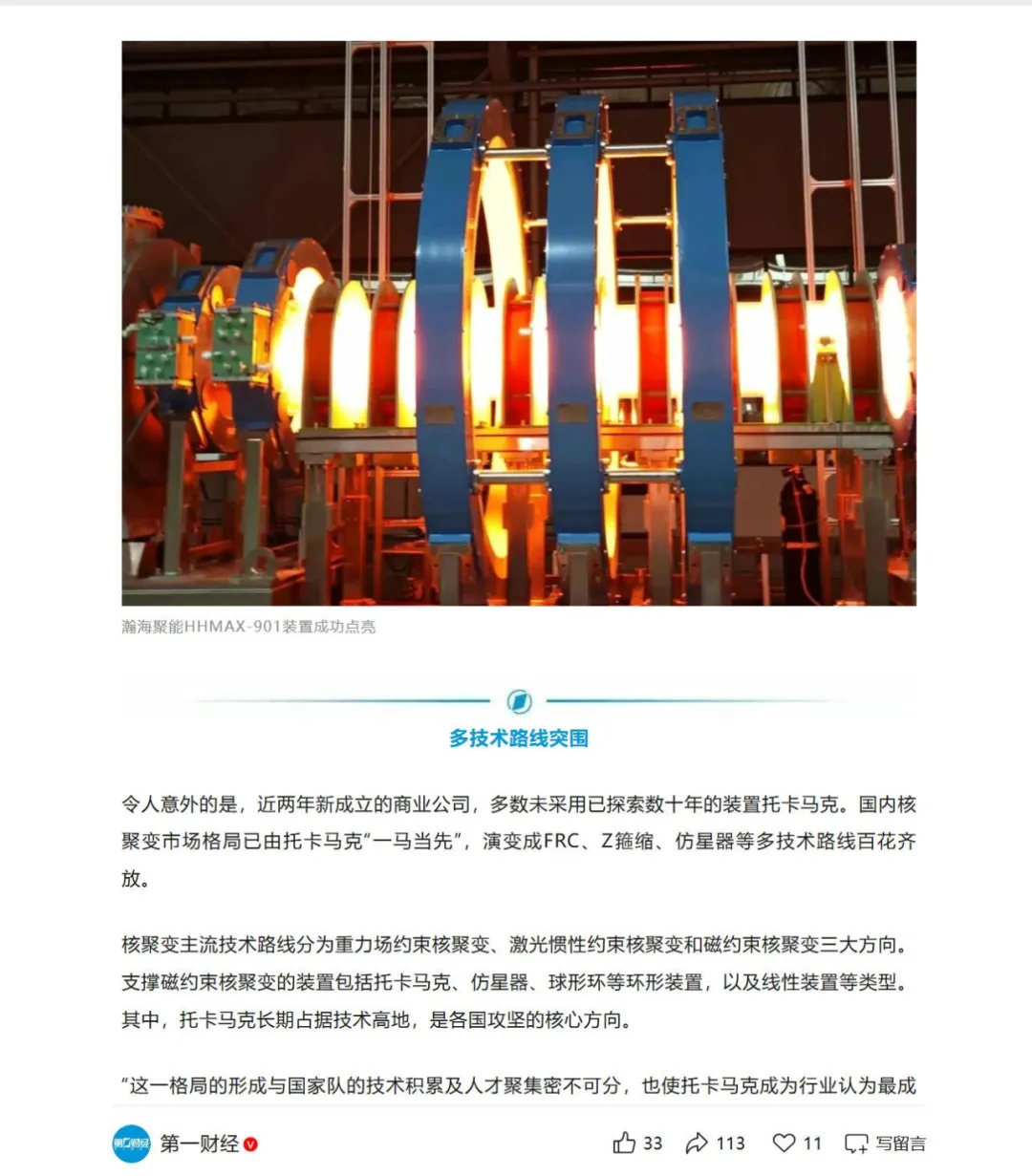
The article mentioned that, surprisingly, most of the commercial companies established in the last two years have not adopted the decades-old tokamak device. The domestic nuclear fusion market landscape has evolved from the tokamak’s dominance to a百花齐放 of multiple technological pathways, including FRC, Z-pinch, and stellarators.
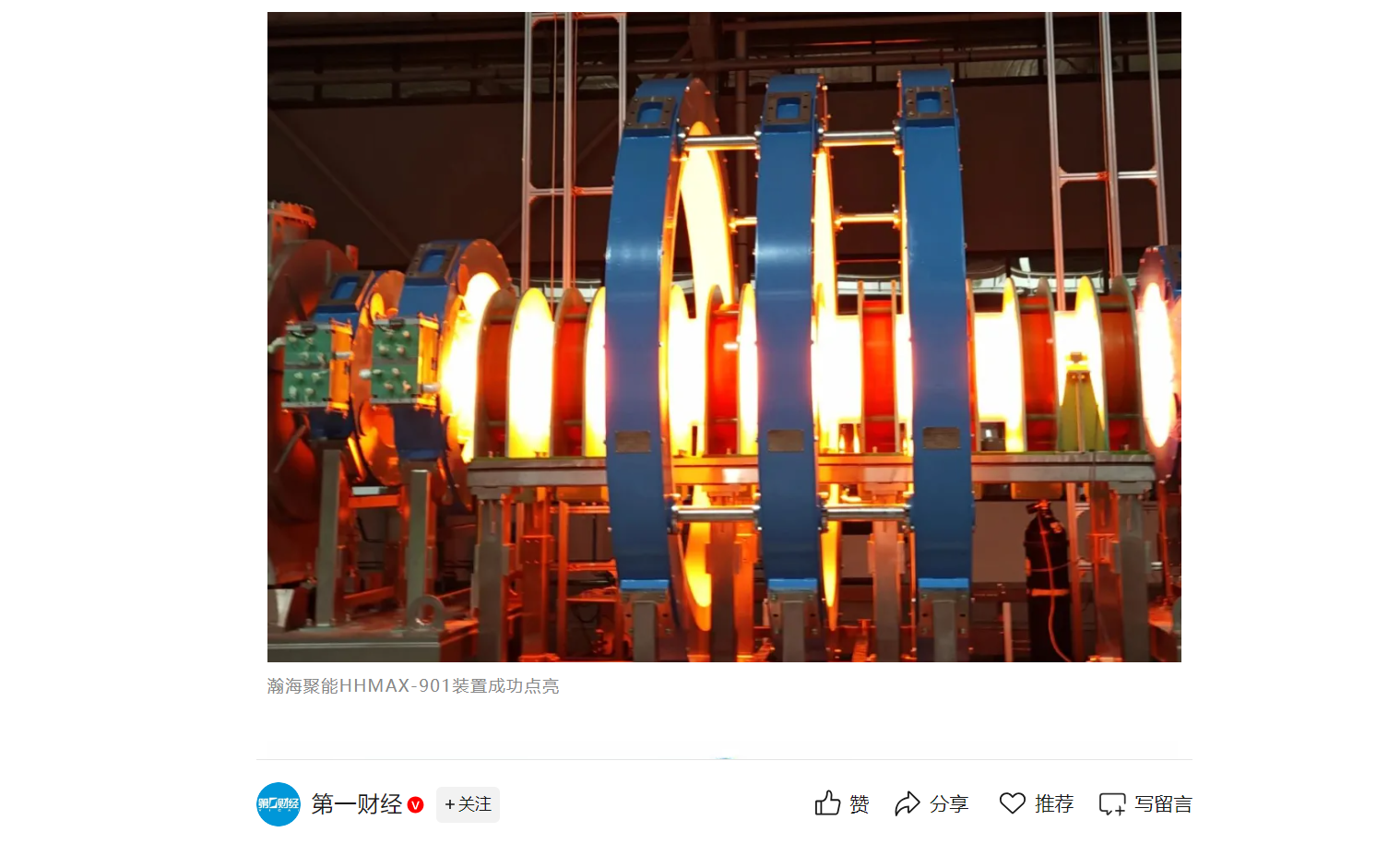
HHMAX-ENERGY is exploring the field-reversed configuration (FRC) pathway, which has the advantage of lower capital requirements. The company’s first-generation device, the HHMAX-901, cost only approximately 200 million yuan, with a levelized cost of electricity comparable to existing coal power. Additionally, key components of this device can be reused in the next generation, significantly accelerating iteration speed. In this regard, HHMAX-ENERGY aligns itself with Helion Energy in the U.S., which follows the same technological pathway. Helion Energy’s seventh-generation device, Polaris, is now operational, aiming to demonstrate net power generation capability. The company has even signed a power purchase agreement with Microsoft, committing to supply 50 MW of fusion power by 2028.
Regarding commercialization, the article analyzed that commercial nuclear fusion power generation still requires thorough scientific and engineering validation. While most companies have shortened this planned cycle to 5–8 years, commercial power generation remains unrealistic in the short term. This inherent difference in commercialization paths between private startups and state-owned entities means that private enterprises must rely on limited funds to "make quick, incremental progress" and rapidly iterate on engineering, while state-owned entities can advance steadily, akin to the aerospace industry, building global competitiveness in talent, technology, and industrial chains.
Startups like HHMAX-ENERGY are initially targeting small-scale distributed power sources ranging from tens to hundreds of megawatts to meet the demands of energy-intensive enterprises such as data centers, smelters, and mining sites. However, the 5–8 year wait for commercial power generation remains particularly long for startups. Those who can achieve self-sustainability first will have the foundation to survive. As a result, many private companies have outlined short-term commercial plans alongside their medium- to long-term goals for commercial power generation. For instance, HHMAX-ENERGY is focusing on nuclear technology applications. By leveraging early-stage fusion technology research, the company is developing neutron source intermediate products planned for use in tumor radiotherapy (boron neutron capture therapy, BNCT), isotope drug production, nuclear fusion material testing, and tritium cycle process validation.

 EN
EN